New Rules FIFA World Cup 2026, Full Guide to Every Rule Change
Every World Cup brings a few surprises, but this year, some of the biggest talking points have nothing to do with goals or red cards in the traditional sense; they’re about the rulebook itself. From the moment the opening whistle blew in the US, Mexico, and Canada, fans have been asking the same question: what exactly are the new rules FIFA World Cup 2026 introduced, and why does the referee suddenly seem so much stricter? Whether you’re a longtime football fan or just tuning in for the World Cup buzz, getting familiar with these changes will make every match easier to follow and far more enjoyable to watch.
New Rules FIFA World Cup 2026, The Complete Guide for Fans
Football fans watching this summer’s tournament have probably noticed referees making calls that simply didn’t exist a few years ago. That’s because the new rules FIFA World Cup 2026 introduced are some of the biggest the sport has seen in a single tournament. The International Football Association Board (IFAB), working alongside FIFA, rolled out a fresh rulebook aimed at cutting down time-wasting, sharpening officiating, and keeping the game flowing for the 48 nations competing across the United States, Mexico, and Canada.
If you’ve been searching for World Cup 2026 new rules and want a simple breakdown without the jargon, here’s everything you need to know.
Why the Rulebook Changed This Year
This is the largest World Cup in history, with 104 matches packed into just over five weeks. With that much football to get through, FIFA wanted to protect the pace and quality of the product for broadcasters, sponsors, and most importantly, fans. That context is the driving force behind almost every one of the 2026 World Cup rule changes you’ll see referees enforcing this summer.
The 10-Second Substitution Rule
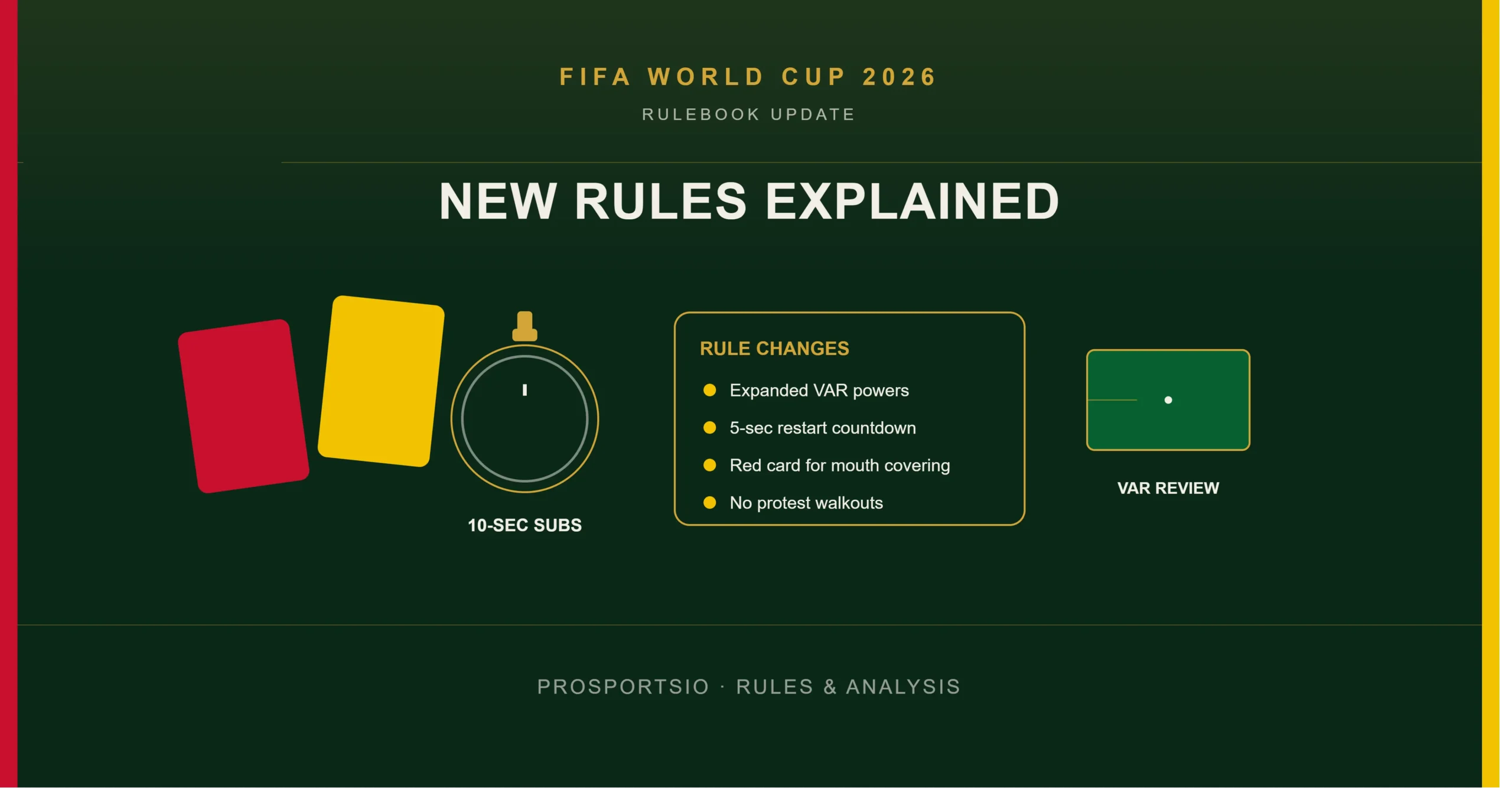
This is the rule that’s generated the most conversation among fans and pundits alike. Once a substitution is signaled, the outgoing player has just 10 seconds to leave the pitch. Miss that window, and the substitution gets frozen, with the new player forced to wait a full minute on the sideline before entering the match.
This isn’t a rule sitting quietly in a manual somewhere, either. During a pre-tournament friendly, Iceland’s Hlynsson took too long walking off, so his replacement had to wait the full minute, and Japan scored during that exact window. It’s a perfect real-world example of why this new rules FIFA World Cup 2026 is being taken so seriously by coaching staff.
Five-Second Countdown on Restarts
Substitutions aren’t the only target of FIFA’s anti-time-wasting push. Referees can now start a visible five-second countdown before a throw-in or goal kick, and a player who ignores it risks handing possession straight to the opposition. It’s a small tweak, but across 90 minutes, it adds up to noticeably less stalling.
VAR Gets More Power
Video Assistant Referee technology isn’t new, but its reach has expanded significantly. Match officials can now review fouls that happen in the buildup to a corner or free kick, including grappling and shirt-pulling inside the box that used to slip under the radar. If that kind of foul is judged to have directly affected a goal or penalty, the referee can intervene even after play has restarted.
This expanded scope is arguably one of the most consequential World Cup new rules 2026 has brought in, since it can literally overturn a goal that’s already been celebrated.
Covering the Mouth Now Means a Red Card
Here’s a rule that surprises a lot of casual viewers. Any player who covers their mouth with a hand, arm, or shirt during a confrontation with an opponent will be shown an automatic red card. The rule is specifically about confrontational situations players having a normal, private chat on the pitch without wanting their lips read aren’t penalized. It’s a direct response to incidents that happened in club football just months before the tournament.
Protesting a Decision Can Get You Sent Off
Player and coach conduct is under the microscope too. Anyone who leaves the field of play to protest a referee’s call can now be shown a straight red card, and coaching staff who encourage that kind of walkout face the same punishment. This rule exists largely because of ugly scenes in other international tournaments where entire benches reacted badly to contentious calls.
No More Hiding Behind Injuries
One of the more subtle changes targets a tactic fans have complained about for years. Referees have been instructed to stop teams from using an injured goalkeeper as an excuse to gather around the bench for an unofficial timeout, even though the injured player still has every right to receive treatment. It’s less about punishing injuries and more about closing a loophole that’s been quietly exploited for ages.
Built-In Hydration Breaks
Not every change is about discipline or punishment. FIFA has also added official hydration breaks around the 22nd minute of each half, a sensible move considering how hot conditions can get across the host cities in the US, Mexico, and Canada during the group stage.
What All This Means If You’re Watching at Home
If you want to follow how these new rules are actually playing out match by match, Prosportsio has been tracking VAR decisions and referee calls throughout the group stage. It’s a good place to see real examples of these rules in action as the tournament continues.
Put together, these new rules FIFA World Cup 2026 represent one of the most significant officiating overhauls football has seen at this level. Quicker substitutions, smarter VAR reviews, and zero tolerance for time-wasting tricks all point toward the same goal: a cleaner, fairer, faster game for everyone watching.
So next time you see a referee start a countdown, send a player off for covering their mouth, or freeze a substitution mid-game, you’ll know exactly why. Understanding the new rules FIFA World Cup 2026 introduced doesn’t just make you a smarter viewer, it makes the whole tournament more fun to watch.